

Research shows that money habits are mostly shaped at home between the ages of four and seven, particularly around core skills such as counting and choice making. For this reason, we believe that we are well placed to have a significant impact on the financial literacy skills of the primary school pupils we work with.
We’ve spent the past two years researching and developing a financial literacy programme to meet the needs of primary school pupils and their families. Find out more about our journey below.
What the research says
Our research has highlighted that real life experience is more effective for learning than simulations or games. The most successful approaches combine face-to-face interaction with hands-on learning, extend beyond the classroom, involve parents, and target younger children. Critically, confidence and self-efficacy are as crucial as acquiring knowledge.
Hearing from parents and teachers
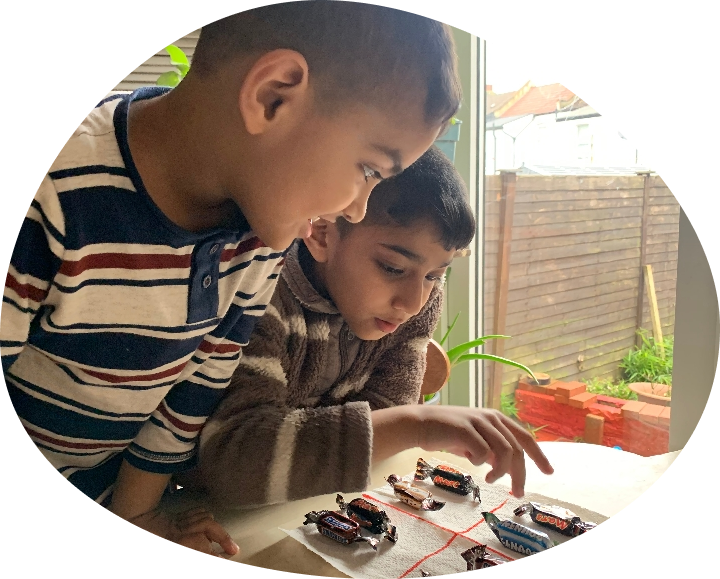
Parent voice work has been critical to the development of our financial literacy offering. Amelia Ernest-Jones, one of our School Partnership Managers, held a parent voice workshop at a school in Bristol in November 2023. The majority of parents in attendance were eligible for Pupil Premium funding.
Parents she spoke to believed in the importance of financial literacy. They were motivated to support their children to develop good money habits but wanted more support to help them to do so. Discussions highlighted the following points:
- The challenge of making financial topics accessible and relatable.
- The importance of inclusivity and meeting a diverse range of needs.
- The need for a cohesive approach which connects home and school.
We have also held a number of teacher focus groups to gain insights into what works for schools. The following were identified as important elements for teachers:
- Integrating financial literacy resources with other elements of the curriculum.
- Flexibility and adaptability within the programme.
- Bridging what is taught in school to real life experience, especially in a climate of rapidly evolving financial systems and norms.
- Effective launch and engagement tools and strategies.
- Models for celebrating achievements.
Designing our financial literacy offering
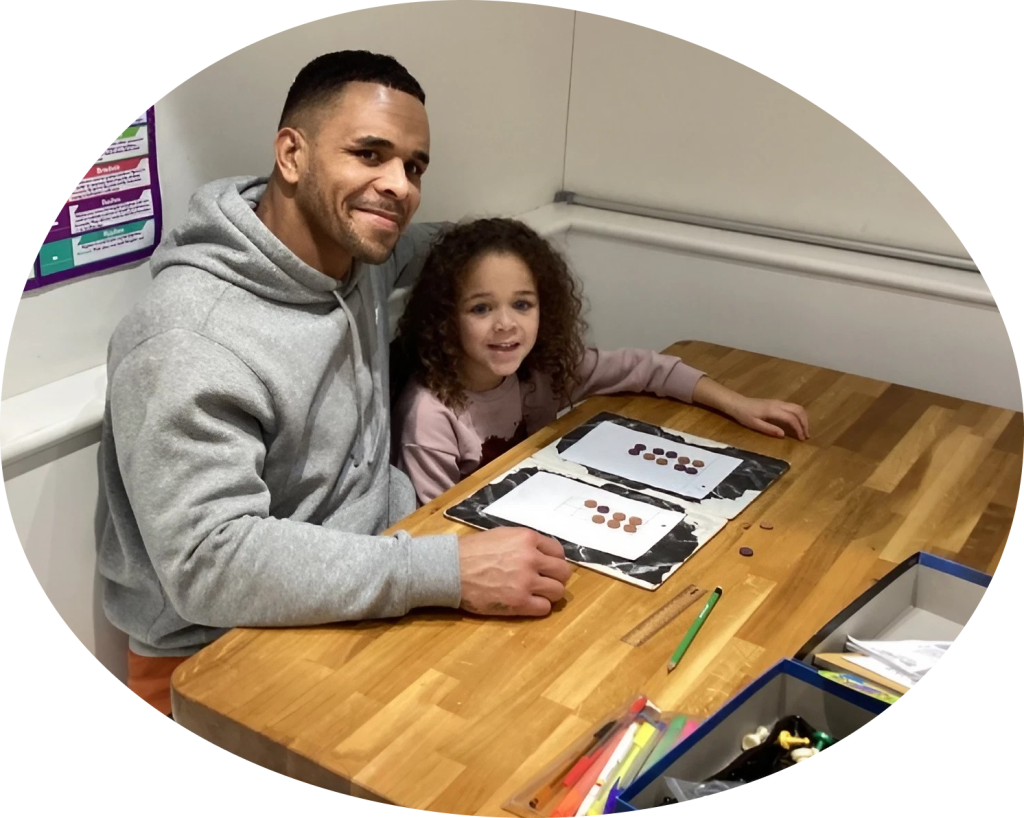
Our financial literacy programme will run across the primary school – EYFS to Year 6. Its purpose is to give children the knowledge, skills and experiences that enable them to manage their own money in the future. It also encourages families to start having conversations about money with their children and gives them the starting points to do so.
The financial literacy programme follows the same format as our Maths and English topics – a short video followed by two or three off-screen activities for children to enjoy with their parents.
Our offering is underpinned by both the Young Money Financial Education Planning Framework and PSHE Association Programme of Study – which are the most widely used, relevant curriculums in the primary age phase.
Schools find it a challenge to find the time to cover Financial Literacy amongst all the other demands on teaching time. By enlisting parents to support this learning, our programme allows it to be included without taking time from other curriculum subjects.
How it works
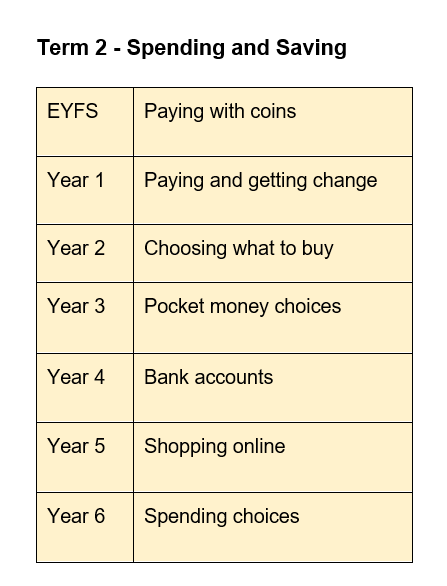
The Learning with Parents financial literacy programme is made up of six strands, with one strand across the school each term.
There is a topic for each year group in each strand. This means if all topics were set, a child would do six topics per school year. We recommend that topic setting and release timing is coordinated across the school so that families with siblings in different year groups can work on them together.
You can see an example of Term 2, Spending and Saving, on the right.
The activities attached to each topic are a mixture of real-world experiences, conversations and games. An introductory slideshow and notes will be provided for each term. These can be used either in an assembly or by class teachers to prepare children for the topic. An information leaflet explaining the programme to parents is also provided and will be available in translation for families with English as an additional language.
Inclusivity in financial literacy education
We know that money can be a sensitive topic for families, particularly in the current climate, and that attitudes vary across cultures and individual families.
Our programme has been planned with disadvantaged families at its heart and is informed by parent focus groups. All of the suggested experiences are designed to be possible on very limited budgets. The messaging throughout the programme encourages families to make the activities their own; to use the suggestions in the context of their own lives and routines; and to have the conversations with their children that they feel are appropriate and relevant.
Next steps
We will be piloting the financial literacy programme with six partner schools in September 2024. Feedback from the pilot will be used to refine and improve the resources, with the aim of launching the programme fully in Autumn 2025.


