


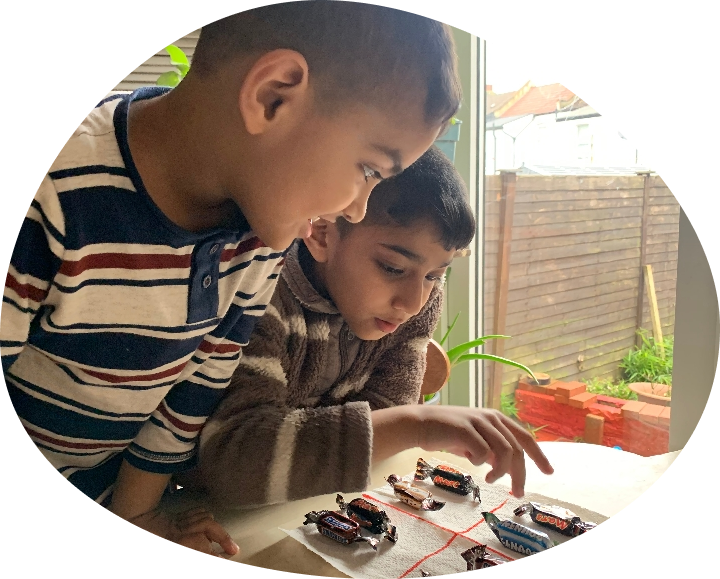


Learning with Parents were excited to welcome Grace Coker from the Education Endowment Foundation (EEF) as the guest speaker for our latest webinar. We discussed the many benefits of maths games and how they can support learning at school and at home.
On a personal note, this is a subject close to my heart. I loved using maths games as a teacher and now, creating them for our platform is one of the best parts of my role at Learning with Parents.
Grace took as her starting point the EEF recommendation to:
“Explore mathematics through different contexts
including storybooks, puzzles, songs, rhymes, puppet
play and games.”
(Improving mathematics in the EY and KS1 guidance report)
Illustrated by video exemplification from the ‘clips from the classroom’ series, she demonstrated how effectively games could, among other benefits, provide repeated practice, reinforce mathematical vocabulary, aid retrieval practice, and provide opportunities for rich, mathematical discussion. Grace emphasised the need for games to be played with purpose in the classroom and for the adults supporting them to be clear about their role in the learning.
Grace also highlighted other EEF guidance that ‘playing with letters and numbers at home is linked to improved outcomes for children’. She mentioned that for younger children there should be a greater focus on activities that parents and children can do together – the mission at the core of Learning with Parents!
Purposeful, playful practice ‘in action’, article by Grace Coker
Working with Parents to Support Children’s Learning, Guidance Report from EEF
Games are not just a great way to engage learners with maths in the classroom, they also work well as activities to send home. A good game should be fun to play, flexible in time and resources, and easily accessible. Games are repeatable and can be played once or many times. Most importantly, they can support families to have enjoyable, positive interactions around learning.
“We all played this game as a family with Luisa’s little brothers and we all had lots of fun.”
Games can also reduce some of the barriers families face when engaging with maths homework. The way maths is taught has changed. Parents are often faced with unfamiliar methods and unknown vocabulary which can be a source of conflict and frustration if they try to help. Maths homework can be particularly difficult if parents are themselves anxious about maths and it risks becoming a time when negative attitudes are passed on. Many parents are also uncertain how much they should help their child. Games remove many of these pressures – there is no ‘right’ thing back to school, a parent’s role is clearer and a bit of fun makes for a better atmosphere!
On the webinar I gave lots of examples of the types of games that work well at home – those with no resources, with simple resources such as dice or counters and fully prepared card games or board games. At Learning with Parents we put a lot of thought into making our games accessible and inclusive – from on-screen dice to showing varied alternatives to counters – so that as many families as possible can have a go, using whatever they have at home.
Place Value Battle – Roll the dice and place your number. Will you play nice or nasty?
Number bond race – How quickly can you hit the matching number?
Addition Competition – Will you use that 6 as a 6,60 or 600? Can you reach the target without going bust?
Chat to one of our team to find out more about our fun and inclusive maths programme and how it could help your school:
Contact Us Share this post on social media
I consent to my quotes being used to promote Learning with Parents’ work, for advocacy, communications and marketing materials or to advertise the product to other schools, or for any other purposes in line with our charitable goals and values. I understand that neither my name, nor any identifying features, will be shared.
We know that supporting children’s learning at home is not always easy for families and we are currently working with your child’s school to gather insights into the barriers parents face to engaging in their child’s learning. These insights will help us develop our programme so that we can support all parents.
We are running parent voice workshops to gather feedback from parents and carers. The insights provided will be used by Learning with Parents to make improvements to our platform and shared with other organisations working in education to strengthen practices. A publication written based on the insights from these discussions will be available on the Learning with Parents website.
Feedback collected will be analysed to identify trends by the Learning with Parents. The feedback you share may also be shared with researchers from another institution. All feedback will be stored and shared anonymously. Data will be held for 5 years to allow for any re-use and will be destroyed after that.
We will record audio of the session to help us transcribe your feedback afterwards. These recordings will not be shared with anyone outside of Learning with Parents and will be deleted within three months.
Your participation is voluntary and you can withdraw your consent at any time.
Your name will not be in any publications, nor will they be shared with anyone.
Learning with Parents is committed to processing information in accordance with the General Data Protection Regulation (GDPR). The personal data collected on this form will be held securely and will only be used for administrative purposes.
You have the right to request to see a copy of the information we hold about you and to request corrections or deletions of the information that is no longer required. You can ask Learning with Parents to stop using your data at any time, in which case it will not be used in future but still analysis or quotes may continue to appear in publications already in circulation. To withdraw your consent, please contact: [email protected].
You have the right to lodge a complaint against Learning with Parents regarding data protection issues with the Information Commissioner’s Office (https://ico.org.uk/concerns/).
Information Commissioner’s Office (https://ico.org.uk/concerns/).
PARTIES
(1) LEARNING WITH PARENTS a registered charity (CIO) in England and Wales with charity number 1189812 whose registered office is Newminster House, Bristol, BS1 1LT (Company);
(2) Your school or setting (School);
WHEREAS
(A) The Company has developed a programme to motivate and empower parents to engage in their child’s learning.
(B) The School wishes to use the Company’s programme to help their children and families.
(C) The Company has agreed to grant access to sections of its website to the relevant school staff and families.
(D) The Company has agreed to provide and the School has agreed to pay for access to the Company’s website on the terms and conditions of this Agreement.
IT IS HEREBY AGREED AS FOLLOWS
1. Definitions
The definitions and rules of interpretation in this clause apply in this Agreement:
In consideration of the School paying the applicable Price to the Company (in accordance with clause 5 below) the Company grants the School a nonexclusive, non-transferable, revocable licence to access, and to allow the Permitted Users to access, the Learning with Parents Package during the Subscription Term.
Subject to payment by the School of the Price (in accordance with clause 5 below), and compliance by the School with its obligations under clause 4 below, the Company agrees to:
3.1 provide the Learning with Parents Package to the School and use reasonable endeavours to ensure it can be accessed by the Permitted Users at all reasonable times.
3.2 work with the School to support increased parental engagement
4.1 provide the Company with such information and materials as the Company may reasonably require to supply the Learning with Parents Package and ensure that such information is accurate in all material respects;
4.2 ensure that only the Permitted Users use the Learning with Parents Package and that they do so inaccordance with the terms and conditions of this Agreement;
4.3 allow the use of the School’s name and logo on the Company’s website and marketing materials;
4.4 no later than 30 days prior to each Subscription Term, provide an accurate estimate of the number of classes whose parents or carers will be offered access to the Learning with Parents Package.
5.1 The Company shall invoice the School up to 30 days prior to the start of each Subscription Term, or earlier if requested by the School, in respect of the Initial price or Ongoing Price, as applicable.
5.2 The School agrees to pay each invoice submitted by the Company within 30 days of the date of the invoice to the account specified in the invoice.
6.1 No part of the Website including but not limited to the Learning with Parents Package and Videos may be reproduced, distributed or transmitted in any form or by any means to anyone other than the Permitted Users without the prior express written consent of the Company.
6.2 The School acknowledges and agrees that the Company owns all Intellectual Property Rights in the Website, the Learning with Parents Package and the Videos and except as expressly stated herein, this Agreement does not grant the School any rights to or in such Intellectual Property Rights.
6.3 The School shall promptly give notice in writing to the Company in the event that it becomes aware of any infringement of any Intellectual Property Rights owned by the Company.
7.1 Without limiting its other rights or remedies each party may terminate this Agreement with immediate effect by giving written notice to the other party if:
7.1.1 the other party commits a material breach of its obligations under this Agreement and (if such breach is remediable) fails to remedy the breach within 30 days after receipt of notice in writing to do so; or
7.1.2 the other party’s financial position deteriorates to such an extent that its capability to adequately fulfil its obligations under the Agreement has been placed in jeopardy.
7.2 Without limiting its other rights or remedies the Company may terminate this Agreement with immediate effect if the School fails to pay any amount due under this Agreement on the due date for payment.
7.3 If the Agreement is terminated pursuant to this clause 7 during a Subscription Term, there will be no refund to the School of the amount of any Price paid by the School in respect of that Subscription Term.
At the end of each Subscription Term, this Agreement shall automatically renew for one additional year as an Ongoing Subscription Term unless written notice of non-renewal is provided to the Company by the School at least 30 days prior to the expiration of the then-current Subscription Term.
The School shall indemnify the Company for any loss suffered by the Company as a result of the School breaching its obligations under this Agreement.
No variation of this Agreement shall be effective unless it is in writing and signed by the parties (or their authorised representatives).
11.1 This Agreement constitutes the entire Agreement between the parties and supersedes all previous agreements, arrangements and understandings between them, whether written or oral, relating to its subject matter.
11.2 Each party agrees that it shall have no remedies in respect of any statement, representation, assurance or warranty (whether made innocently or negligently) that is not set out in this Agreement.
11.3 Each party agrees that it shall have no claim for innocent or negligent misrepresentation or negligent misstatement based on any statement in this Agreement.
Neither party shall assign, transfer, subcontract, or deal in any other manner with any or all of its rights and obligations under this Agreement without the prior written consent of the other party.
This Agreement may be executed in any number of counterparts, each of which when executed shall constitute a duplicate original, but all the counterparts shall together constitute the one agreement.
This Agreement does not confer any rights on any person or party other than the parties to this Agreement and where applicable their successors and permitted assigns pursuant to the Contracts (Rights of Third Parties) Act 1999.
This Agreement and any dispute or claim arising out of or in connection with it or its subject matter or formation (including non-contractual disputes or claims) shall be governed by and construed in accordance with the law of England and Wales.
Each party irrevocably agrees that the courts of England and Wales shall have exclusive jurisdiction to settle any dispute or claim arising out of or in connection with this Agreement or its subject matter or formation (including non-contractual disputes or claims).
The parties acknowledge that they have read and understand this Agreement and voluntarily accept the duties and obligations set forth herein.

Evaluation Manager
Nienke worked as a university lecturer for several years before moving into evaluation and mixed‑methods research in the education sector. She has led research at the University of Bristol on how best to support students and developed the evaluation framework for the London NCOP (now UniConnect). Nienke is passionate about using evidence to highlight and address educational inequalities, and has worked with organisations such as AccessHE and the Sutton Trust to identify biases and barriers within the education system.

Early Years Curriculum Lead
Amie began her career in education through the Teach First programme, but her passion for teaching started much earlier — in a makeshift childhood classroom, leading lessons for her teddies! Since then, her career has been shaped by a commitment to addressing educational inequality. She has worked across early years settings, supported disadvantaged families through her work with a charity and developed early years curriculum as a freelance writer. Her work is grounded in the belief that the early years lay the foundation for lifelong learning — and that lasting change in education starts with equity, compassion and a deep commitment to nurturing every child’s potential.

Marketing and Sales Lead
Aimee has worked in marketing and communications across the arts and charity sectors for several years, most recently for a music education charity before joining the Learning with Parents team. She is passionate about equity, diversity, and inclusion, and strives to champion these values in all of her work.

Fundraising Manager
Libby has spent the last five years in fundraising across universities and the not-for-profit sector in Australia. She’s passionate about education as a force for real social change and absolutely loves connecting with people and building partnerships that genuinely matter. Libby is driven by a commitment to tackling educational inequality and ensuring every child gets the chance to thrive.

School Partnership Manager
Jo spent 24 years as a dedicated primary school teacher, mainly in Key Stage 1, and held leadership roles in both KS1 and EYFS. Throughout her career, she was passionate about developing children’s love for reading and writing, serving as English Subject Leader for many years. She led a range of inclusive initiatives to promote reading for pleasure, both in school and at home, with a strong focus on engaging all families. Jo is now excited to be part of the Learning with Parents team, where she supports schools in strengthening parental engagement and helping to close the achievement gap for disadvantaged children.

Technology and Systems Lead
Chris began his career as a software engineer, before transitioning to a leadership role during the COVID-19 pandemic, when he discovered how much he enjoys navigating chaos and uncertainty. He is passionate about mentorship and strives to help people develop and hone new skills.